Regular air conditioning maintenance keeps your system working efficiently. It helps lower energy bills, prevents sudden breakdowns, and extends the lifespan of your unit.

Servicing also improves indoor air quality and ensures the system runs safely. With just a little effort, you can protect your investment and enjoy consistent comfort throughout the year.

Why Air Conditioning Maintenance Matters

Air conditioning maintenance involves a series of routine checks and tasks aimed at keeping your unit running smoothly.

This includes inspecting components, cleaning filters and coils, checking refrigerant levels, and ensuring all parts are in good condition. These steps help to maintain efficient cooling, which is especially important during warmer months.

Without proper maintenance, your system has to work harder, leading to increased energy consumption and a higher chance of faults. Regular upkeep not only improves performance but also helps avoid unexpected repair costs.

Professional HVAC services often include maintenance packages that ensure your system gets the attention it needs to run efficiently all year.

The Cost of Neglecting Regular Maintenance

Neglecting maintenance allows dirt and wear to build up. This strain on the system can lead to component failure and poor performance. Filters clog, coils become dirty, and refrigerant may leak over time.

These common AC problems cause higher energy use, reduced cooling, and even complete system failure if left unresolved.

In many cases, fixing these issues is more expensive than routine servicing. Regular maintenance helps you avoid these problems early and saves money in the long run.

Key Benefits of Regular Aircon Servicing

Servicing your air conditioning system regularly provides clear benefits. A well-maintained unit cools more effectively and uses less energy, which means lower utility bills. This makes your home or workplace more comfortable while keeping running costs down.

Aircon servicing also helps to improve indoor air quality. Clean filters and components stop dust and allergens from circulating in your space. For those with allergies or respiratory issues, this can make a big difference.

Another major benefit is extending the life of your system. By catching issues early, you avoid major failures that could lead to replacement.

Regular servicing is part of effective HVAC services and supports energy-efficient air conditioning across all environments.

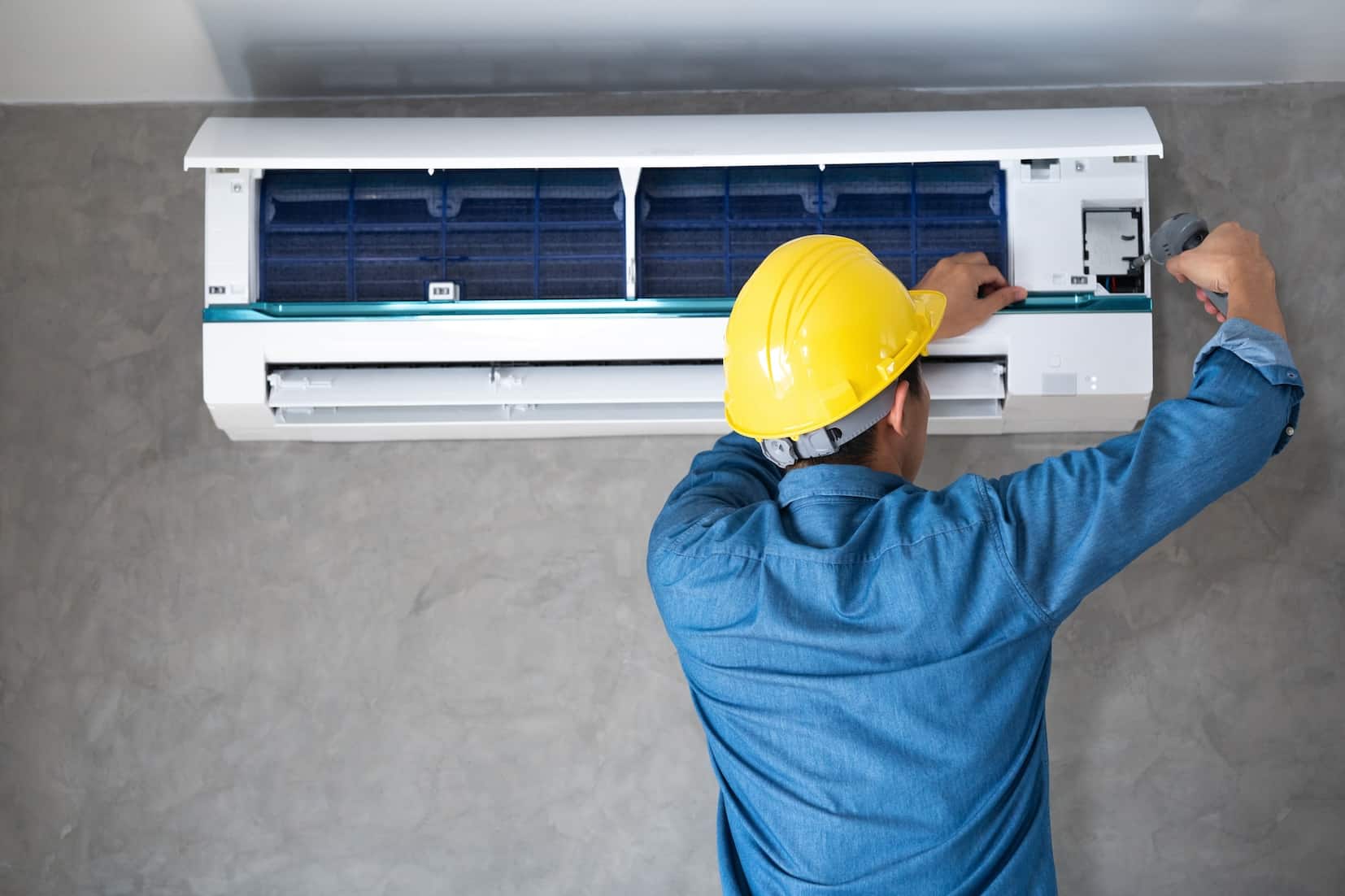
Portrait of a male technician repairing air conditioner in his office

AC Maintenance Checklist: What Should Be Done?

An AC maintenance checklist ensures that all vital tasks are completed during a service. This helps keep your system running efficiently and prevents small problems from turning into big ones.

Here are the essential tasks:

  • Clean or replace air filters
  • Check refrigerant levels and look for leaks
  • Clean condenser and evaporator coils
  • Inspect ductwork for signs of damage or leaks
  • Tighten electrical connections
  • Test the thermostat and controls
  • Lubricate moving parts where needed

Following a detailed AC maintenance checklist gives you peace of mind and keeps your system operating at peak performance.

How Often Should You Service Your Air Conditioning System?

Most air conditioning systems should be serviced once a year. This is usually best done before the warmer months when you rely on your AC the most.

However, in areas with frequent use or in commercial settings, servicing every six months is often more effective.

Residential systems typically need annual attention, while commercial systems, which work harder and more often, benefit from more frequent check-ups.

Keeping to a regular schedule reduces the risk of breakdowns and helps the system last longer.

Air conditioning technicians install new air conditioners in homes, Repairman fix air conditioning systems, Male technician service for repair and maintenance of air conditioners

Identifying Common AC Problems Before They Worsen

Spotting issues early helps prevent expensive repairs.

Some of the most common AC problems include:

  • Weak or uneven airflow
  • Leaks around the unit
  • Strange noises during operation
  • Thermostat reading inaccurately

These signs often start as small issues but grow worse if ignored. For example, a clogged filter may seem minor but can lead to reduced cooling and stress on the motor.

Early detection through regular maintenance avoids these problems and keeps your system reliable.

Choosing the Right HVAC Services Provider

Selecting the right HVAC services provider ensures your air conditioning maintenance is done properly. Look for companies with qualified technicians, strong reviews, and clear service options. A good provider will offer flexible service plans and respond quickly when needed.

CoolStream delivers expert HVAC services with a focus on quality and reliability. Our maintenance plans help you avoid unexpected repairs and keep your system running efficiently year-round.
To learn more or schedule a service, visit our Air Conditioning Services page.

Conclusion: A Small Effort for Long-Term Gains

Regular air conditioning maintenance offers real, long-term benefits. It keeps your system efficient, reduces energy use, and helps avoid breakdowns. Clean air, steady cooling, and fewer repair bills are just a few of the advantages.

Book your next service check to protect your system and enjoy uninterrupted comfort.
Contact Us for Tailored Solutions Today!

What Our Customers Say:

"Efficient and Neat"

Your installation team worked very well alongside the other tradesmen to achieve an efficient and neat installation and I would certainly recommend your services.

"Efficient and Neat"

Your installation team worked very well alongside the other tradesmen to achieve an efficient and neat installation and I would certainly recommend your services.
Office Refurbishment Project Manager
Company Name

"Good Tidy Professional Installation"

I was impressed with the good tidy professional installation carried out by CoolStream. I’ve received all the relevant manuals and certificates.

"Good Tidy Professional Installation"

I was impressed with the good tidy professional installation carried out by CoolStream. I’ve received all the relevant manuals and certificates.
Aerospace Industries Facilities Manager
Company Name

"Excellent Service"

CoolStream’s maintenance team really improved our air conditioning systems. Excellent service, I couldn’t have asked for more!

"Excellent Service"

CoolStream’s maintenance team really improved our air conditioning systems. Excellent service, I couldn’t have asked for more!
Office Supplies, Office Manager
Company Name

An air conditioner that works well is something we often take for granted—until it doesn’t. Whether at home or in a commercial space, a failing AC can quickly become more than just an inconvenience.

The good news is, most problems don’t appear out of nowhere. There are usually signs that something isn’t right. Catching those signs early can save you from high repair bills, wasted energy, and unexpected breakdowns.

In this article, we’ll look at the common signs your air conditioner might be struggling, and when it’s time to call in a professional.

Why Timely Air Conditioning Repair Matters

It’s tempting to ignore small issues with your AC, especially if it’s still mostly doing its job. But even minor problems can get worse over time.

What starts as a faint noise or a slight drop in performance could end in a full breakdown. That’s when the costs start to add up—both in money and in discomfort.

Quick air conditioning repair prevents larger issues and keeps your home or business running smoothly. Regular air conditioning maintenance also gives you a chance to fix wear and tear before it turns into something serious.

Common Signs Your Air Conditioner Needs Repair

Most AC problems come with a few warning signs. The trick is knowing what to look for so you can act before things get worse.

Here are five signs your air conditioner might need some attention:

Warm Air Coming from Vents

When your system starts blowing warm air instead of cool, it’s a sign that something’s wrong.

It could be a problem with the compressor or a refrigerant issue. Either way, it’s time to book an air conditioning service.

Weak Airflow or Inconsistent Cooling

If some rooms feel cooler than others, or the air just doesn’t seem to be flowing well, there could be a blockage or a fan issue.

An experienced AC technician can help track down the cause and get things working properly again.

Strange Noises or Bad Smells

No air conditioner should make loud or unusual sounds. If you hear buzzing, grinding, or banging, something might be loose or broken inside.

Bad smells, like something burning or a musty scent, can also mean trouble. These are problems best left to a professional HVAC service.

High Energy Bills or Poor Efficiency

Noticing a spike in your energy bills? If your usage hasn’t changed, your AC might be working too hard to do its job. That usually points to a fault somewhere in the system.

Regular air conditioning maintenance helps keep things running efficiently and your bills under control.

Water Leaks or Excess Moisture

A little condensation is normal, but puddles or constant dampness are not. Leaks can come from blocked drains or broken parts and might lead to water damage if left alone.

Getting air conditioning repair quickly can prevent further problems.

When to Call a Professional AC Technician

Some issues are easy to spot, but fixing them isn’t always straightforward. If your system keeps shutting off, won’t cool properly, or shows any of the signs above, it’s best to bring in a qualified AC technician.

They’ll have the tools and knowledge to sort out the issue safely and make sure your system’s in good shape.

Many HVAC services also offer inspections that can catch small faults before they turn into major repairs.

Benefits of Regular Air Conditioning Maintenance

A well-maintained air conditioner lasts longer, performs better, and is less likely to break down unexpectedly.

During a maintenance visit, the technician will check key parts, clean components, and test the system to make sure it’s running as it should. It’s a simple way to avoid bigger problems down the line and ensure steady cooling.

Booking regular air conditioning maintenance once or twice a year is a smart move that can save money and hassle.

An air conditioning technician is diligently working on a cooling unit in a commercial space, ensuring proper functionality during the warm afternoon
Hospitality

Commercial Air Conditioning Services: What Businesses Should Know

Air conditioning problems in a business setting can be a real headache. Whether it’s a retail space, office, or hospitality venue, a breakdown can impact staff and customers alike.

That’s where commercial air conditioning services come in. These services are geared towards larger, more complex systems and include fast response times, repairs, and maintenance plans.

Having a maintenance contract means regular check-ups and priority support when things go wrong.

Final Thoughts: Stay Cool and Avoid Costly Repairs

Your air conditioner doesn’t just stop working overnight. It gives off signs—and the sooner you catch them, the better.

Whether it’s warm air, weak airflow, odd sounds, or rising energy bills, don’t ignore the warning lights.

Calling in a professional air conditioning service can save you money, time, and stress. Keep your system running smoothly by acting early and keeping up with routine checks.

Contact Us for Tailored Solutions Today!

What Our Customers Say:

"Efficient and Neat"

Your installation team worked very well alongside the other tradesmen to achieve an efficient and neat installation and I would certainly recommend your services.

"Efficient and Neat"

Your installation team worked very well alongside the other tradesmen to achieve an efficient and neat installation and I would certainly recommend your services.
Office Refurbishment Project Manager
Company Name

"Good Tidy Professional Installation"

I was impressed with the good tidy professional installation carried out by CoolStream. I’ve received all the relevant manuals and certificates.

"Good Tidy Professional Installation"

I was impressed with the good tidy professional installation carried out by CoolStream. I’ve received all the relevant manuals and certificates.
Aerospace Industries Facilities Manager
Company Name

"Excellent Service"

CoolStream’s maintenance team really improved our air conditioning systems. Excellent service, I couldn’t have asked for more!

"Excellent Service"

CoolStream’s maintenance team really improved our air conditioning systems. Excellent service, I couldn’t have asked for more!
Office Supplies, Office Manager
Company Name

Installing air conditioning isn’t just about staying cool—it’s about making your home or business more comfortable, more efficient, and more liveable.

With UK summers getting warmer, air conditioning is no longer a rare luxury. This guide breaks down everything you need to know about installation, helping you understand the different systems available, what to expect during the process, and how to keep things running smoothly afterward.

Whether you’re fitting out a cosy flat or upgrading a commercial space, the goal is the same: find the right system, get it installed properly, and enjoy the difference it makes.

Why Air Conditioning Installation Matters

Proper installation is what makes or breaks your air conditioning system. A well-fitted unit cools more effectively, uses less energy, and lasts longer.

If corners are cut during installation, you could end up with a noisy, underperforming system that costs more to run.

For homeowners, air conditioning adds comfort during those muggy summer nights. In workplaces, it improves air quality and creates a better environment for both employees and customers. It’s not just about temperature—it’s about making spaces more enjoyable to be in.

Different types of buildings need different solutions. What works in a modern semi might not suit a listed building or a large office. That’s why choosing the right system—and a reliable installer—is so important.

Types of Air Conditioning Systems

Domestic Air Conditioning Systems

Most people are familiar with split systems, where an indoor unit is connected to an outdoor unit.

They’re great for individual rooms, offering quiet, efficient cooling. Wall-mounted units are popular in bedrooms and living spaces, while portable systems work well if you’re renting or only need cooling occasionally.

Domestic systems are easy to use and can improve indoor air quality by filtering out dust and allergens. For many households, they’re a practical, long-term solution to managing indoor temperatures.

Why Air Conditioning Installation Matters

Commercial systems are built to cope with higher demands. Ducted systems, which distribute air through ceiling vents, are ideal for open-plan offices or large shops.

Multi-split setups allow multiple indoor units to connect to a single outdoor unit, which saves space. VRF and VRV systems are designed for buildings where different rooms need different temperatures.

These systems are commonly found in offices, hospitality venues, and retail environments—anywhere that consistent climate control is essential.

Factors to Consider Before Installation

Before you get started, think about the size and layout of your space. A small unit won’t keep a large room cool, but a unit that’s too big will cycle on and off too often, wasting energy.

Energy efficiency is key. Look for systems with strong efficiency ratings—they’ll help you save on electricity bills. Noise is another factor to consider. If you’re installing a unit in a bedroom or meeting room, quieter models will make a big difference.

The type of property matters too. Older homes might need electrical upgrades or special permissions, especially if you’re in a listed building. It’s worth having a professional assess your property before you commit.

The Air Conditioning Installation Process

First, a qualified installer will visit your property to assess your needs. They’ll measure the space, talk through your options, and recommend a system that suits both your budget and your building.

Once the equipment arrives, the indoor and outdoor units are fitted and connected. This involves running pipework, securing brackets, and checking everything is aligned and sealed properly.

After installation, the system is tested. The installer will check the controls, make sure there are no leaks, and walk you through how to use it.

Common Installation Challenges

Not every building makes installation easy. Outdoor units need good airflow and may require planning in flats or listed properties. Thick walls or limited access can slow things down.

That’s why working with experienced professionals is essential—they’ll know how to adapt and get the job done properly.

Post-Installation: Maintenance & Repair

Air Conditioning Maintenance

Like a car, air conditioning works best when it’s looked after. Annual servicing keeps it running efficiently.

This usually involves cleaning or changing filters, checking for leaks, and making sure all components are in good shape.

Air Conditioning Repair

Sometimes things go wrong—a drop in cooling power, unusual noises, or unexpected leaks. If that happens, it’s best to call a professional.

Fast repairs stop minor issues from turning into costly problems.


hvac technician install ducted heat recovery ventilation system with recuperation

HVAC Installation vs. Traditional AC Systems

HVAC systems are more comprehensive. They don’t just cool—they also heat and ventilate.

They’re a solid choice for larger buildings or anywhere you want full climate control all year round.

While they take more time and money to install, HVAC systems can be more efficient in the long run. If you only need cooling, though, a traditional air conditioning setup might make more sense for your needs.

Final Tips and Takeaways

Getting the right air conditioning setup is about more than picking a product—it’s about making sure it suits your space, is installed properly, and is easy to maintain.

Choose a trusted installer, ask questions, and don’t cut corners.

If you’re ready to make your space more comfortable, CoolStream is here to help. We offer expert advice, professional installation, and reliable aftercare.

Contact Us for Tailored Solutions Today!

How long does air conditioning installation take?

Most home installations take a day or two. Larger jobs might take longer depending on the complexity.

Can I install air conditioning myself in the UK?

No. Installation must be done by a certified professional to comply with UK regulations and keep your warranty valid.

What maintenance does a new AC unit need?

Annual servicing is recommended. This includes filter cleaning, refrigerant checks, and a general inspection.

What’s the best system for a small home?

Split or wall-mounted units are usually the best fit. They’re energy-efficient, quiet, and easy to control.

How much does air conditioning cost to run?

Running costs vary based on usage and system efficiency. High-efficiency models usually cost less to operate over time.

What Our Customers Say:

"Efficient and Neat"

Your installation team worked very well alongside the other tradesmen to achieve an efficient and neat installation and I would certainly recommend your services.

"Efficient and Neat"

Your installation team worked very well alongside the other tradesmen to achieve an efficient and neat installation and I would certainly recommend your services.
Office Refurbishment Project Manager
Company Name

"Good Tidy Professional Installation"

I was impressed with the good tidy professional installation carried out by CoolStream. I’ve received all the relevant manuals and certificates.

"Good Tidy Professional Installation"

I was impressed with the good tidy professional installation carried out by CoolStream. I’ve received all the relevant manuals and certificates.
Aerospace Industries Facilities Manager
Company Name

"Excellent Service"

CoolStream’s maintenance team really improved our air conditioning systems. Excellent service, I couldn’t have asked for more!

"Excellent Service"

CoolStream’s maintenance team really improved our air conditioning systems. Excellent service, I couldn’t have asked for more!
Office Supplies, Office Manager
Company Name

If your business relies on keeping products cold, then commercial refrigeration isn’t just important — it’s essential.

Whether you’re running a busy restaurant, a convenience store, or a healthcare facility, keeping your refrigeration systems working properly protects your stock, saves you money, and keeps your doors open.

In this guide, we’ll walk through why these systems matter, what types are available, how to look after them, and when it’s time to bring in the experts.

The Importance of Commercial Refrigeration for Business Operations

Supporting Key Sectors: Hospitality, Retail & More

Refrigeration keeps things fresh, safe, and ready to use. In hospitality, it helps kitchens run smoothly. In retail, it keeps food and drink looking great and tasting even better. In healthcare, it’s critical for storing medicine at the right temperature.

Without proper refrigeration, stock can spoil, customers may lose trust, and you could face serious health and safety issues. It’s not something businesses can afford to ignore.

Benefits of Reliable Commercial Refrigeration

A reliable system does more than keep things cold. It helps you cut energy costs, reduce waste, and avoid emergency call-outs.

It also gives your team one less thing to worry about. When your system works as it should, everything else runs more smoothly too.

Types of Commercial Refrigeration Systems

Walk-in Fridges & Freezers

Perfect for busy kitchens or food warehouses, these large units offer plenty of space and consistent temperatures. They’re built for volume and reliability.

Display Fridges and Chillers

These are the ones customers see. Used in shops, cafés and delis, they need to be efficient, clean, and quiet — all while showing off your products in the best light.

Cold Rooms and Storage Solutions

Cold rooms are the go-to option when you need lots of space and strict temperature control. You’ll find them in supermarkets, labs, wholesalers, and any business handling sensitive stock.

Why Regular Refrigeration Maintenance Is Crucial

Avoiding System Downtime & Product Loss


Even a short breakdown can mean losing hundreds or thousands of pounds in spoiled goods.

Regular servicing helps catch problems early, reducing the risk of failure and giving you peace of mind.

Improving Energy Efficiency & Equipment Lifespan


Clean systems run more efficiently. When your fans, filters, and coils are working properly, they don’t need to work as hard — which means lower energy bills and a longer lifespan for your equipment.

Compliance with Health & Safety Standards


If your fridge or freezer doesn’t stay within a safe temperature range, you could fall foul of food safety laws. And if your system contains refrigerant gases, you also need to follow environmental regulations.

Keeping everything in check with regular maintenance is the simplest way to stay compliant.

An industrial freezer filled with boxes of raw seafood, showcasing neatly organized packaging. Ideal for food storage, inventory management, and commercial kitchen settings.
Empty commercial freezer with clean shelves and bright lighting.

Common Issues & When to Call for Commercial Fridge Repair

Signs Your System Needs Attention


Noisy fans, dripping water, ice where it shouldn’t be, or fluctuating temperatures are all red flags.

If you spot any of these, it’s best to get them looked at before they turn into bigger issues.


When Emergency Refrigeration Repair Is Needed


If your fridge or freezer stops working altogether — especially during busy service hours — it’s an emergency.

The quicker you act, the more stock you can save. That’s why many businesses choose providers who offer fast, 24/7 response times.

Maintaining Your System: Simple Tips for Business Owners

Little things make a big difference. Keep doors closed when not in use. Log temperatures daily. Make sure vents aren’t blocked and seals are in good shape. Once a week, take a closer look — check for frost, leaks, or anything out of the ordinary.

These basic habits can catch early signs of trouble and help your system run more efficiently.

Conclusion: Stay Cool, Stay Compliant, Stay Operational

Your refrigeration system is the quiet backbone of your business. Keeping it in good shape means fewer breakdowns, lower running costs, and safer stock.

Routine maintenance goes a long way, and when things do go wrong, having a trusted expert on hand makes all the difference.

Contact Us for Tailored Solutions Today!

What Our Customers Say:

"Efficient and Neat"

Your installation team worked very well alongside the other tradesmen to achieve an efficient and neat installation and I would certainly recommend your services.

"Efficient and Neat"

Your installation team worked very well alongside the other tradesmen to achieve an efficient and neat installation and I would certainly recommend your services.
Office Refurbishment Project Manager
Company Name

"Good Tidy Professional Installation"

I was impressed with the good tidy professional installation carried out by CoolStream. I’ve received all the relevant manuals and certificates.

"Good Tidy Professional Installation"

I was impressed with the good tidy professional installation carried out by CoolStream. I’ve received all the relevant manuals and certificates.
Aerospace Industries Facilities Manager
Company Name

"Excellent Service"

CoolStream’s maintenance team really improved our air conditioning systems. Excellent service, I couldn’t have asked for more!

"Excellent Service"

CoolStream’s maintenance team really improved our air conditioning systems. Excellent service, I couldn’t have asked for more!
Office Supplies, Office Manager
Company Name

British summers now bring temperature spikes that many homes cannot handle. Heavy walls, small windows and loft insulation trap heat long after dark.

This guide shows practical ways to stay cool, from simple morning routines to energy-efficient systems. Follow each step and you will breathe easier, sleep better and protect health when the mercury climbs.

Why UK Homes Overheat in Summer

Most British houses were built for cold, wet winters. Solid brick and stone absorb warmth all day, then release it indoors at night. Large panes of unshaded glass face the sun for hours, raising indoor readings far above the outdoor shade mark. Modern loft insulation cuts winter bills yet slows heat escape once the roof heats up.

City streets add a “heat-island” layer, lifting air temperature through stored solar energy and exhaust fumes. Humid air compounds the problem because sweat evaporates slowly, so the body struggles to cool itself.

Our homes accept daytime warmth, keep it, and then offer little relief after sunset. Understanding these causes helps you match each fix to the right weak spot.

Beach chairs on the beach with a sailboat in the background

Quick Wins to Reduce Indoor Temperature (UK-Friendly Tips)

Tackling peak heat starts with simple habits that cost pennies. Open upper and lower windows at dawn to sweep out stale air while outside readings sit below 20 °C. By mid-morning, close windows and draw curtains on any wall that faces direct sun; light-coloured blackout fabric can cut solar gain by a third.

Avoid using the oven before 9 p.m., and switch off idle gadgets because every watt turns to indoor heat. Trade heavy meals for cold dishes to keep body heat lower. Place a frozen water bottle in front of a desk fan; rising air flows across ice, giving an instant cool breeze.

Keep bedding light and mist sheets just before sleep; evaporation steals heat from skin for half an hour, enough time to drift off. Each move trims peak readings without adding to your power bill.

Night-Time Ventilation & Cross-Breezes

The coolest outdoor air often arrives after midnight. Create a pathway so it glides through the whole home. Crack ground-floor windows by five centimetres and secure them with lockable stops. Open a skylight or loft hatch to let warm air escape upward because hot air rises.

If the layout allows, place a floor fan in a hallway pointing outward; it pulls cool air from other windows and pushes hot air outside. Shut interior doors to steer flow through bedrooms. This cycle can drop top-floor temperature by two to three degrees before sunrise.

Daylight Shading & Reflective Barriers

Stopping sunlight before it enters glass is twice as effective as blocking it indoors. Clip a temporary awning or shade sail above south-facing windows. Stick removable reflective film on panes during June and roll it off in September. Fit thermal blackout blinds close to the glass to trap the warm-air layer.

White or silver surfaces reflect more radiation, so choose pale fabrics. Even a simple sheet of white card taped to the outside frame can lower room temperature. In one Leeds terrace, adding a small exterior awning and film dropped living-room highs from 31 °C to 27 °C.

Smarter Use of Fans

Fans move air; they do not chill it, yet airflow speeds sweat loss and makes skin feel three degrees cooler. Put a tower fan in the doorway so it pulls cooler hall air into a stuffy lounge. Angle the fan up slightly to mix warm ceiling air with cooler floor air, evening out the layer.

A ceiling fan should spin anti-clockwise in summer, pushing air down. At today’s rates a 45-watt pedestal fan costs about one pence per hour, far less than a kettle. For an extra kick, soak a thin cloth, freeze it flat and drape it over the guard; droplets evaporate and cool the stream.

Energy-Efficient Cooling Technology

Portable evaporative coolers draw air across wet pads and can trim room temperature by three degrees in dry heat. They sip power at about 70 watts yet work best when humidity sits below 60 per cent, which often occurs during continental-style heat domes.

For stronger relief, look at split-system heat-pump air conditioners. A modern 2.5 kW model cools a double bedroom and costs roughly 18 p per hour to run. Select one with an A+++ label and a high seasonal efficiency, then pair it with a smart thermostat. Keep the setpoint at 26 °C and run a ceiling fan; airflow lets you feel as cool as 23 °C while trimming energy use by a fifth.

Renters can try a window-mounted portable air conditioner; seal the vent panel tight to prevent warm air leaks. Check indoor and outdoor noise ratings and place condensers away from neighbour windows.

Match size to space—about 125 watts per square metre for bedrooms and 150 watts for open-plan areas—to avoid overspending on capacity you will never use.

When to Consider Air Conditioning Installation UK

Cooling moves from luxury to need when nightly bedroom readings stay above 29 °C, older residents lose sleep, or you work long hours on a top floor. Fixed air conditioning delivers quiet, steady relief and dries humid air, easing breathing for asthma and allergy sufferers.

A single-room split unit starts near £1 500 fitted, rising with pipe length and outdoor bracket work. An efficient system adds only £1–£2 on a peak day thanks to inverter compressors that throttle output once the setpoint is met.

Book surveys between September and March when engineers have gaps and suppliers offer deals. Some heat-pump units qualify for grants under the Boiler Upgrade Scheme in England and Wales; homeowners receive up to £7 500 for switching from gas boilers to air-source pumps, which cool in summer and heat in winter.

Check planning rules: most single-family homes can add an outdoor unit under permitted development, but flats need freeholder permission.

An air conditioning technician is repairing air conditioners in the room

Choosing an Air-Conditioning Installer Near You

Pick an F-Gas registered engineer; this licence proves training in safe refrigerant handling. Ask for public liability insurance and a five-year parts warranty. Local firms reach faults faster, so searching “air conditioning installer near me” pays off when heat strikes again.

Read reviews that mention punctuality and clean-up. A good installer sizes equipment with a heat-load calculation and provides a written quote itemising parts, labour and call-out fees. CoolStream AC offers free surveys and yearly servicing plans that keep warranties valid.

Long-Term Home-Design Upgrades

External roller shutters block up to 90 per cent of solar heat while still allowing light when angled. Solar-control glazing has a clear metal-oxide layer that reflects infrared yet keeps rooms bright.

Adding 300 millimetres of rigid loft insulation slows heat flow into bedrooms beneath the roof. A sedum green roof forms a living blanket that shields the top floor and softens rain runoff.

To support steady airflow, install trickle vents with secure night latches so you can leave windows partially open even when away. For new builds, orient living spaces north or east and design overhangs that shade high-summer sun while letting in low winter rays.

Spread improvements over several years to match budgets yet chip away at the main causes of indoor heat.

Heatwave Safety & Health Tips

During alerts, sip water often and skip alcohol, which raises heat stress. Dress in loose cotton and mist skin for instant cooling. Keep babies in the coolest room, around 18–20 °C, and check the back of the neck for sweat.

Pets need shade and a ceramic tile to lie on; never leave animals in parked cars. Store medicines below 25 °C unless the label states cooler. Watch for heatstroke: hot dry skin, rapid pulse, confusion or cramps.

Move anyone showing these signs to shade, cool their skin with wet cloths and call 999.

Check on neighbours aged over 75; simple visits save lives.

Conclusion & Next Steps

Beat UK heatwaves with three layers of action.

First, adopt simple daily habits that push hot air out and block sunlight.

Second, add energy-smart devices such as ceiling fans, evaporative coolers and efficient split systems.

Third, plan long-term upgrades or fit fixed air conditioning when peak heat threatens comfort or health. For clear advice and a free home survey, contact CoolStream AC before the next hot spell arrives.

FAQ – Your Heatwave Cooling Questions Answered

Is an air conditioner worth it in the UK?

Yes, if heat disturbs sleep or health; efficient units cost little to run.

Should I open windows during a heatwave?

Open them at dawn and night, close them with curtains drawn during direct sun.

How can I sleep when it is 30 °C?

Use a fan across a damp sheet, freeze a gel pillow and wear light cotton.

Do blackout blinds really work?

They block light and cut solar heat by about one-third.

Can loft insulation keep the house cooler?

Yes, it slows roof heat transfer, reducing upstairs temperature spikes.

What size air con do I need?

About 125 watts per square metre for bedrooms and 150 watts for open-plan areas.

Are portable units helpful?

They cool small rooms but need a sealed vent kit to avoid pulling warm air back inside.

Will an air purifier fan cool me?

It improves air quality but does not lower temperature; pair it with a cooler or AC.

Does reflective window film affect winter warmth?

Good film reflects mainly summer infrared, so winter heat loss change is small.

Contact Us for Tailored Solutions Today!

What Our Customers Say:

"Efficient and Neat"

Your installation team worked very well alongside the other tradesmen to achieve an efficient and neat installation and I would certainly recommend your services.

"Efficient and Neat"

Your installation team worked very well alongside the other tradesmen to achieve an efficient and neat installation and I would certainly recommend your services.
Office Refurbishment Project Manager
Company Name

"Good Tidy Professional Installation"

I was impressed with the good tidy professional installation carried out by CoolStream. I’ve received all the relevant manuals and certificates.

"Good Tidy Professional Installation"

I was impressed with the good tidy professional installation carried out by CoolStream. I’ve received all the relevant manuals and certificates.
Aerospace Industries Facilities Manager
Company Name

"Excellent Service"

CoolStream’s maintenance team really improved our air conditioning systems. Excellent service, I couldn’t have asked for more!

"Excellent Service"

CoolStream’s maintenance team really improved our air conditioning systems. Excellent service, I couldn’t have asked for more!
Office Supplies, Office Manager
Company Name

Air curtains create an invisible, high-speed air screen across open doorways. The barrier keeps warm air inside during winter and cool treated air inside during summer. Staff and visitors pass freely through the stream, so buildings avoid bulky vestibules or revolving doors.

Each avoided draught cuts heat loss, reduces chiller load, and welcomes customers with a pleasant entrance. Commercial sites across the UK install air curtains UK-wide to guard entrances in shops, warehouses, and offices. Savings grow with each door cycle, making the pay-back period short and clear.

By holding conditioned air where it belongs, a modern air curtain can trim energy use by up to thirty percent while improving comfort for everyone inside, and supporting carbon reduction goals.

What Are Air Curtains and How Do They Work?

An air curtain is a fan unit mounted above or alongside a doorway that discharges a narrow, fast jet of air across the full width of the opening. The jet meets outside air and forms a barrier that limits mixing between the two air masses.

Because the indoor and outdoor temperatures differ, the airstream bends slightly back toward the warmer side, which further strengthens the seal. Sensors linked to the fan modulate speed so the curtain responds to door status and traffic flow, using only the power needed.

In practice, commercial air curtains draw room air through a filter, accelerate it with an axial or centrifugal impellor, and guide it through a shaped nozzle that produces a uniform velocity profile. Discharge velocity typically ranges between seven and twelve metres per second, high enough to resist wind gusts yet low enough for quiet operation. Some models include heating coils—electric, hot-water, or heat-pump—to raise the leaving air temperature for added comfort in colder seasons.

Whether heated or ambient, correctly sized units stop up to eighty percent of doorway heat loss, protect indoor air quality, and pay back their installation cost in a short time when doors open often.

The Science Behind the Invisible Air Barrier

A moving sheet of air behaves like a light, flexible door. When expelled at the right speed, the jet sticks to itself through shear forces and keeps its shape from grille to floor. Pressure on the warm side pushes the stream outward while cooler outdoor air presses inward, creating a balanced line that seals the gap.

Because the two air bodies stay separate, temperature, humidity, and airborne particles remain on their own side of the doorway. Most of the jet’s energy is kinetic rather than thermal, so the running cost per hour is low. Laboratory tests show that a correctly tuned curtain can block four out of five cubic metres of infiltration, even in windy conditions. That stability boosts savings.

Main Types of Commercial Air Curtains

Commercial air curtains fall into four groups. Ambient units use room air and suit warehouses or summer entrances. Electric heated models warm the jet with resistance coils and give instant comfort in cold weather.

Hot-water coils link to a boiler and offer high heat output at low running cost. Heat-pump units capture waste warmth from the building to raise efficiency. Recessed styles hide within a ceiling grid, while industrial models span bay doors up to five metres high.

Core Air-Curtain Benefits for UK Commercial Buildings

Air Curtains

Air curtains give businesses three clear gains: reduced energy loss, improved indoor air quality, and lower heating and cooling bills. At busy entrances a door can open hundreds of times an hour, creating a conveyor belt that drags treated air outside. By sealing that opening, a curtain shrinks the energy penalty of each cycle, leaving boilers and chillers with less work to do. Studies from UK supermarkets show annual gas savings above fifteen per cent and electrical savings above ten per cent after installation.

The barrier also blocks dirt, fumes, and insects that ride in on gusts. Fewer pollutants reach sales floors, reception desks, and storage areas, so staff breathe cleaner air and products stay in better condition. Comfort rises too, because temperature by the doorway stays steady rather than swinging with every trolley movement.

Finally, the cumulative cost saving is significant. Lower plant load means smaller utility bills and a flatter demand curve, which can unlock cheaper energy tariffs. Some owners even downsize replacement equipment because peak heating demand falls. When capital outlay and running costs are compared, a standard commercial air curtain in the UK often pays back within eighteen months, and its service life exceeds a decade.

Additional air curtain benefits include discouraging birds that might enter, reducing slip hazards by keeping rain spray outdoors, and allowing open-door trading that invites footfall without penalty. All day long safely.

Cutting Energy Loss at Doorways

Each opening event acts like a pump that exchanges indoor and outdoor air. Commercial air curtains stop this pump by forcing a controlled, downward jet across the threshold. The jet divides the two environments so leakage drops to a fraction of its former rate.

Thermal imaging in office lobbies shows surface temperature around the doorway rising by up to six degrees after installation. Less escaping heat means boilers cycle less often, which extends their service life and cuts carbon output.

Improving Indoor Air Quality & Comfort

Outdoor air can carry exhaust fumes, pollen, dust, and insects that spoil indoor comfort. By limiting uncontrolled inflow, an air curtain forms a first defence before the HVAC filters take over. Customers no longer feel a sudden chill or whiff of diesel when the door swings open.

Staff working near the reception desk report fewer colds and sore throats. Because the curtain keeps the micro-climate stable, thermostats hold set-point with less modulation, which further boosts wellbeing throughout the day.

Lowering Heating and Cooling Costs

Energy modelling for a mid-size fashion shop in Manchester found that installing an ambient air curtain cut annual gas use by 12,000 kWh and electricity by 4,000 kWh. At current UK tariffs that equates to roughly two thousand pounds saved each year.

If a heated unit replaces plug-in fan heaters near the door, savings grow again because the curtain runs at a higher coefficient of performance. On the cooling side, peak demand can drop enough to avoid hiring a temporary chiller during summer sales events and improves grid load factors.

Heated Air Curtains for Doors: Added Efficiency and Comfort

Heated air curtains for doors combine the barrier effect with a gentle wash of warm air, easing the transition between outdoor and indoor climates. In shops and restaurants, that welcoming breeze encourages customers to linger near displays placed close to the entrance, boosting sales potential.

The coil lifts the discharge temperature by ten to twenty degrees, yet the overall energy use often still falls because heat loss through the doorway plunges. For buildings with gas boilers, tying the unit into the low-temperature circuit gives cheap heat that keeps running costs modest. Electric models suit sites that benefit from surplus renewable power or time-of-use tariffs, while heat-pump coils score highest on seasonal efficiency when linked to a reversible VRF system.

Many heated curtains carry variable output control. During milder weather the coil throttles back, delivering the barrier with minimal extra heat. On frosty mornings it shifts to full output and prevents the cold plume that used to creep across the floor. Users notice warmer feet and fewer complaints about draughts.

Because the warmth blows downwards, it does not disrupt lighter conditioned air stratified at ceiling level, so comfort improves without wasting energy aloft. This dynamic response keeps pay-back periods reassuringly short.

When to Specify Heated vs Unheated Models

Choose a heated model when people pause near the door, for example in cafés, chemists, or ticket offices. If staff stand on a reception desk directly in the airflow, the extra warmth stops chilled shoulders. Ambient units work well for warehouses, plant rooms, and supermarket goods entrances where staff wear jackets.

Temperature set-back times matter too: heated curtains recover comfortable conditions quickly after overnight shutdown, which helps businesses that open early. If the site operates an electric vehicle charger or solar PV, selecting an electric coil may absorb surplus power.

Balancing Running Costs and Payback

Running cost depends on coil type, local tariffs, and hours of use. Electric resistance heat costs around thirty pence per kilowatt-hour on a standard contract, whereas gas boilers supply heat at roughly ten pence per kilowatt-hour equivalent. Hot-water coils therefore give the shortest pay-back where gas is available.

A heat-pump coil, linked to a VRF, can drive cost below five pence per kilowatt-hour during mild weather by moving, rather than creating, heat. Include fan energy in the calculation: a curtain draws less than half a kilowatt at full speed. When savings from reduced infiltration are counted, the yearly net cost is negative, so the curtain pays back from day one.

Installing Commercial Air Curtains in the UK — Best Practices

Correct installation determines how well an air curtain performs and how long it lasts. Before ordering, survey the site to record door width, height, wind exposure, and traffic pattern. Measure clearance above the lintel and note any lights or sensors that might block airflow.

Select a unit that covers the full opening with at least ten per cent overlap on each side and delivers a discharge velocity high enough to reach the floor. Installers then mount the chassis as close to the doorway as practical, ideally within fifty millimetres, to keep the stream intact.

Electrical connections must follow BS 7671 and include local isolation for safe maintenance. If fitting a hot-water coil, lag the pipework and provide automatic air vents at the high points. For heat-pump coils, follow the manufacturer’s refrigerant guidelines and pressure-test the system before pulling vacuum. Door-open contacts or infrared sensors should link directly to the curtain controller so the fan ramps up only when needed, extending motor life and saving power.

Once commissioned, the installer should demonstrate simple user checks, supply the maintenance schedule, and record airflow and noise readings for reference. In Scotland and coastal regions, engineers may specify marine-grade stainless housings to resist salt spray, materials.

Site Assessment and Sizing


Begin by counting door cycles at peak and off-peak periods to estimate annual operating hours. Measure the height to the finished floor and the clear width between the jambs. Record wind pressure readings if the entrance faces prevailing winds, as this influences required jet velocity.

Select a model that matches or exceeds the door width, as under-sizing leaves gaps that leak air and waste power, and note planned future extensions.

Positioning for Maximum Performance


Mount the air curtain as close to the door head as space allows so the jet reaches the floor before spreading. If ceiling height is generous, fit side panels to guide airflow and stop cross-drafts. Angle the nozzle two degrees toward the outside to counter negative pressure that might draw the stream indoors. Keep lighting, signage, and security cameras clear of the discharge path, as any obstruction breaks the sheet and reduces effectiveness. Use hangers that dampen vibration for quietness.

Why Professional Installation Matters


Certified installers understand airflow, electrical safety, and control integration. They test velocity with calibrated anemometers and adjust fan speed to match door height. They commission sensors, set run-on timers, and train staff in daily checks. This expertise prevents early failure, ensures the manufacturer’s warranty stays valid, and delivers the energy savings promised in the proposal. They also document serial numbers, balance water circuits, and file compliance records for building inspections.

Portrait of a male technician repairing air conditioner in his office
air curtains above shop

Maintenance Tips to Maximise Energy Savings

Routine maintenance keeps airflow strong and energy use low. Inspect the intake grille each month and vacuum dust that can choke the fan. Wash or replace filters quarterly to maintain design pressure.

Check motor bearings for noise and play, lubricating according to the maker’s schedule. On heated models, bleed the coil at the start of each heating season and confirm water temperature with a digital probe. Test door sensors to ensure the fan switches off within five seconds of the door closing. Record airflow velocity and noise levels annually; a sudden fall points to obstruction or belt wear. While the cover is off, tighten electrical terminals and examine insulation for signs of heat.

These small tasks take less than an hour yet preserve the door seal, cut breakdowns, and hold running costs at their lowest point. Schedule a deep clean every three years to remove grease build-up in hospitality locations.

ROI Comparison: Air Curtains vs Vestibules and Automatic Doors

Many architects consider vestibules or automatic sliding doors to control drafts, yet both carry higher capital and operating costs than an air curtain. A framed vestibule can require structural work, finishes, and extra cleaning, pushing the installed price beyond £12,000 for a single retail entrance. Automatic sliders cost less up front but still leak conditioned air every time the leaf moves, and their drive units draw power all day.

In contrast, a commercial air curtain for the same opening costs around £3,000, installs within one shift, and draws power only when the door activates. Energy modelling across three UK climates found that vestibules saved 35 % of heat loss, sliders 20 %, and air curtains 28 %. When investment and savings are combined, the curtain achieved a pay-back in 1.5 years, the vestibule in 5 years, while the sliders never paid back within their service life under typical footfall assumptions.

Start Saving Energy and Money with a Custom Air Curtain Solution

Air curtains give commercial buildings a proven path to lower energy bills, steadier comfort, and cleaner indoor air. By sealing the most active opening without hindering footfall, they deliver savings every minute a door swings.

Whether you need ambient protection for a warehouse or heated air curtains for doors on a busy high street, Coolstream can design and fit the right solution.

Book a free survey today, and see how quickly your site could start saving money and carbon. Our engineers use precise airflow modelling, local climate data, and real energy prices to build a clear, reliable return-on-investment forecast. Today.

Contact Us for Tailored Solutions Today!

What Our Customers Say:

"Efficient and Neat"

Your installation team worked very well alongside the other tradesmen to achieve an efficient and neat installation and I would certainly recommend your services.

"Efficient and Neat"

Your installation team worked very well alongside the other tradesmen to achieve an efficient and neat installation and I would certainly recommend your services.
Office Refurbishment Project Manager
Company Name

"Good Tidy Professional Installation"

I was impressed with the good tidy professional installation carried out by CoolStream. I’ve received all the relevant manuals and certificates.

"Good Tidy Professional Installation"

I was impressed with the good tidy professional installation carried out by CoolStream. I’ve received all the relevant manuals and certificates.
Aerospace Industries Facilities Manager
Company Name

"Excellent Service"

CoolStream’s maintenance team really improved our air conditioning systems. Excellent service, I couldn’t have asked for more!

"Excellent Service"

CoolStream’s maintenance team really improved our air conditioning systems. Excellent service, I couldn’t have asked for more!
Office Supplies, Office Manager
Company Name

Temperatures in the UK can now top 40 °C —the national record of 40.3 °C was set at Coningsby, Lincolnshire, on 19 July 2022 —and early Met Office outlooks suggest summer 2025 will again be hotter than average, with a realistic chance of further extreme-heat days. Roads may soften, rail services may slow, and server rooms in small and medium-sized firms must stay cool regardless, so following our emergency checklist is more vital than ever.

When processors overheat, phones go silent, payment portals freeze, and customer trust drains away in minutes. Effective server room air conditioning prevents that spiral, even during a fierce heatwave.

This article explains the rising risk, sets clear temperature limits, and gives a step-by-step emergency plan. Follow it to keep email live, data safe, and revenue flowing while the mercury climbs, and stay a step ahead of rivals who wait for luck instead of planning.

Why UK Heatwaves Endanger Your IT Infrastructure

Heatwaves now strike the UK with growing force. Met Office records show a 33 percent rise in days above the official heatwave threshold since 2010, and climate models point higher still. Many server rooms, however, rely on cooling sized for a gentle 25 °C summer, built when racks drew half today’s power.

A modern four-post rack loaded with switches, storage, and a modest GPU node can dump more than 8 kW of heat into a space little larger than a wardrobe. Each extra degree of outside air pushes compressors harder and leaves thinner margin before shutdown alarms. Business impact arrives fast: studies put average downtime cost for an SME near £4 000 a minute once lost orders and staff overtime combine.

Repeated outages erode brand confidence and hurt search rankings when online stores vanish from view. Understanding the risk in simple numbers helps leaders approve investment before the next red warning.

The server room features advanced cooling technology, a sleek, futuristic vibe, and captivating deep blue LED illumination that enhances its high-tech appeal.

How Hot Is Too Hot? Server-Room Cooling Thresholds & Compliance

International best practice keeps supply air between 18 °C and 27 °C with relative humidity at 40–60 %. Two major standards—BS EN 50600 and ISO/IEC 22237—list those bands, and most warranty terms follow them.

Drift above 30 °C and processors draw more current to hold clock speed, driving a loop called thermal runaway. Hard-disk lubricants thin, SSD controllers throttle, and UPS batteries lose life. UK Energy-related Products rules add efficiency pressure: from 2025, new splits under 12 kW must score at least SEER 5.1.

Systems holding more than 5 t CO₂e of refrigerant also need documented leak checks under F-Gas law. Keep service sheets and pressure logs in a digital folder so audits run smoothly. Meeting these limits also trims electricity spend, because efficient coils and fans move more heat with fewer kilowatt-hours every hour of the year.

Rapid Assessment: Early-Warning Signs of Overheating

Overheating rarely strikes without hints. A sudden jump in return-air temperature is the first clue, often followed by louder server fans as internal loops chase the rising load. Operators may spot humidity drift, and UPS units can beep if battery modules climb above 30 °C. Install at least one web-enabled sensor per rack and set a text alert at 25 °C so staff see problems during lunch, not after five.

Compare supply and return trends daily in July and August. If the gap narrows, blocked tiles or clogged filters have robbed airflow. A quick walk with a thermal camera pinpoints the spot before the room cooks. Early action is cheap: lift a floor tile, clear a vent, or swap a £10 filter, and reclaim hours of safe running.

Emergency Server Room Cooling Options

An amber heatwave alert often appears less than forty-eight hours before the spike, so the plan must sit ready. Emergency server room cooling falls into three methods.

Portable spot coolers roll through a doorway and vent heat through flexible ducts, perfect for a single hot rack.

Rental split or packaged direct-expansion units deliver higher duty over a week-long event, provided there is a safe space for the outdoor section.

For larger estates, trailer-mounted chillers can feed temporary air handlers or the building’s coil circuit.

Each method has limits: spot coolers need close sockets; splits require drains and pipe routes; chillers demand crane lifts and three-phase power. Map these constraints now, store drawings, and circulate the supplier list so duty staff can act when forecasts worsen.

A high-tech server room that guarantees top data security and connectivity.

Portable Air Conditioning for Server Rooms

Portable air conditioning for server room rescue is the fastest lifeline. A single unit stands about a metre tall, draws up to 1.5 kW from a 13 A socket, and provides roughly 4 kW of cooling. Allow 0.3 kW of cooling for every 100 W of IT heat, then add twenty percent spare. Keep duct runs short and smooth; each bend loses airflow.

Fit a condensate pump if staff cannot empty tanks at night. Aim the discharge grille low on the rack face to neutralise the hot column that rises behind dense blades. Hire costs start near £90 a week, far cheaper than an hour of downtime. Keep one contract pre-approved so paperwork never stalls delivery.

Deploying Backup Server Room AC Units

A standby server room AC unit gives deeper security. Engineers connect it to the same pipework as the lead pair but leave the compressor idle. A temperature relay sits between controller and contactor; if values drift, the relay opens, the failing unit drops out, and the standby starts within seconds.

Monthly test runs keep oil moving and reveal hidden faults. Fit a dial-out module that rings duty staff whenever redundancy is lost. During a long heatwave, rotate duty between units every six hours to balance wear. Combine hardware with clear roles and a printed switch-over checklist. One avoided outage often repays the bill.

Maintenance Moves Before the Heat Hits

Preventive care costs peanuts next to emergency hire. Replace or wash return filters monthly from May to September; a clean panel can cut fan energy by fifteen percent and keep coils free of lint. Inspect condenser fins with a torch and straighten bent sections using a plastic comb.

Check outdoor fan motors for wobble and confirm vibration mounts stay tight. Record suction and discharge pressures and compare them with commissioning baselines; a steady fall hints at a slow leak. Under F-Gas law, systems above 5 t CO₂e must be leak-tested at least every quarter, so book visits early.

Update controller firmware during cool weather so revised algorithms hit set-point smoothly. Run a full load test each April while ambient air is mild, exercising generators, bypass valves, and all alarm paths. Keep signed records in a cloud folder so anyone on shift can prove compliance instantly.

Step-by-Step Emergency Cooling Checklist

  1. Monitor the Met Office site at 07:00 daily; move to heightened readiness on an amber or red alert.
  2. Export the last seven days of temperature graphs from every rack sensor; check for creeping rises.
  3. Switch built-in server room cooling to high-duty mode and verify all lead and standby units report healthy status.
  4. Walk the room: clear vents, seal missing blanking panels, and close spare doors.
  5. Position portable spot coolers at racks above sixty percent CPU load; route ducts directly outdoors.
  6. Call the pre-approved hire firm and confirm delivery slots for extra units or trailer chillers.
  7. Brief staff and suppliers by email, stating current room temperature and the target of 26 °C supply air.
  8. If return air stays above 30 °C for ten minutes, begin staged shutdown of non-critical services, starting with batch jobs.
  9. Log room data every fifteen minutes during the peak; treat each reading as live evidence for the post-event review.
  10. When ambient air drops below 26 °C, return cooling to normal, power up servers in priority order, and archive all notes.

Contact Us for Tailored Solutions Today!

What Our Customers Say:

"Efficient and Neat"

Your installation team worked very well alongside the other tradesmen to achieve an efficient and neat installation and I would certainly recommend your services.

"Efficient and Neat"

Your installation team worked very well alongside the other tradesmen to achieve an efficient and neat installation and I would certainly recommend your services.
Office Refurbishment Project Manager
Company Name

"Good Tidy Professional Installation"

I was impressed with the good tidy professional installation carried out by CoolStream. I’ve received all the relevant manuals and certificates.

"Good Tidy Professional Installation"

I was impressed with the good tidy professional installation carried out by CoolStream. I’ve received all the relevant manuals and certificates.
Aerospace Industries Facilities Manager
Company Name

"Excellent Service"

CoolStream’s maintenance team really improved our air conditioning systems. Excellent service, I couldn’t have asked for more!

"Excellent Service"

CoolStream’s maintenance team really improved our air conditioning systems. Excellent service, I couldn’t have asked for more!
Office Supplies, Office Manager
Company Name